
Donut Spare Tire Change in New Orleans
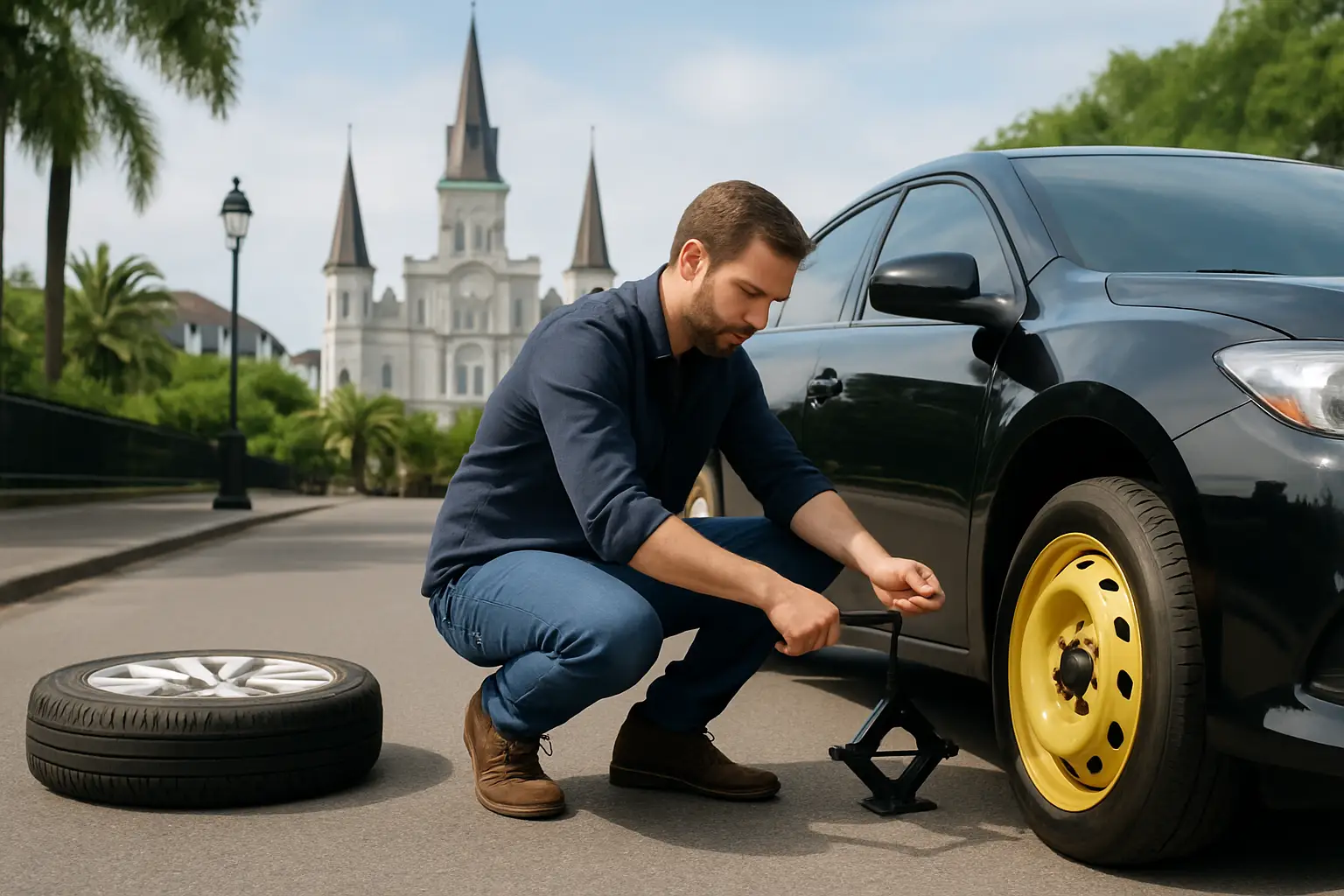
You hear it first - that fast, hollow thump-thump that wasn’t there a minute ago. In New Orleans, a flat can happen anywhere: I-10 by the split, a dark stretch near the Industrial Canal, or a tight curbside spot in the Quarter where there’s barely room to breathe, much less jack up a car.
If your plan is to throw on the spare donut and keep moving, you’re thinking in the right direction. But donut spares come with real limits, and the “quick change” can turn into a safety problem if you’re on soft shoulders, uneven pavement, or a street where traffic never slows down. This guide breaks down when a donut is the right move, when it’s not, and how a tire change service for spare donut New Orleans drivers call for can save time, prevent damage, and get you back on the road without the extra headache.
The donut spare is a solution, not a free pass
A donut spare (also called a temporary spare) is designed for one job: get you off the roadside and to a shop. It’s smaller, lighter, and not built for the same speed, distance, or handling as your regular tire.
Most temporary spares are rated for about 50 mph and short distances, often around 50-70 miles, depending on the tire and vehicle. That’s not “drive the rest of the week and deal with it later.” That’s “get to a tire shop today.” The trade-off is convenience: a donut is easy to store and easy to install, but it reduces traction and stability, especially in rain or when you have to brake hard.
It also changes how your car sits and how the drivetrain behaves. On some all-wheel drive vehicles, driving on a mismatched tire size can stress the system. On performance cars, low-clearance vehicles, or cars with larger wheels, a donut can feel sketchy fast.
When a donut tire change is the right call
There are plenty of situations where installing the donut is exactly what you should do. If you’re in a safe location with level ground, good lighting, and enough space from traffic, a temporary spare can get you to the nearest tire shop without needing a tow.
A donut makes sense if the flat is a simple puncture, the wheel isn’t damaged, and you can safely get the vehicle jacked up. It also helps if you’re close to your destination and can replace or repair the tire quickly.
The key word is safely. New Orleans roads can be uneven, shoulders can be narrow, and some breakdown spots are just not suitable for roadside work.
When it’s smarter to call for a tire change service
A lot of tire changes fail for predictable reasons: the lug nuts are seized, the jack won’t lift on a slope, or the spare is flat too. Other times it’s not the car, it’s the location.
If any of these apply, calling a tire change service is usually the right move:
- You’re on the interstate shoulder, a bridge approach, or anywhere cars are flying by
- The ground is soft, muddy, sloped, or broken up (a jack can sink or slip)
- You don’t have the key for locking lug nuts
- You’re missing tools, the scissor jack is bent, or you can’t loosen the lugs
- It’s raining hard, visibility is low, or it’s late and you don’t feel safe
There’s also the “hidden damage” scenario. If you hit a pothole or curb and the tire went instantly flat, the wheel may be bent or the sidewall may be torn. A donut might still mount, but driving on it could be rough, and if the wheel is damaged badly enough, you may need a tow anyway.
What to do right now if you’re stuck with a flat in New Orleans
Start with positioning and visibility. If you can roll to a safer spot - a parking lot, a wide shoulder, a well-lit area - do it slowly and carefully. Don’t drive far on a shredded tire, but moving 100 feet to a safer spot can make a major difference.
Turn on hazards immediately. At night, interior lights and a flashlight help you be seen while you work or while you wait. If you have reflective triangles, set them out. Then set the parking brake and keep passengers in the vehicle if you’re near traffic.
Before you even touch the jack, check the spare. People find out too late that their donut is underinflated. A donut that’s low on air is not a usable spare.
How a professional donut spare tire change actually helps
A tire change sounds simple until it isn’t. A proper roadside change is about more than swapping rubber.
First, a pro can assess whether a donut is appropriate for your vehicle and situation. If you’re in a spot where jacking the car is unsafe, the best service is often “don’t risk it.” That’s not inconvenience, that’s preventing a jack slip, undercarriage damage, or a roadside injury.
Second, pros deal with stubborn lug nuts every day. If you’ve ever bounced on a lug wrench and nothing moved, you already know the problem. Over-torqued lugs, corrosion, and missing adapters are common. A trained operator arrives prepared for real-world issues, not best-case scenarios.
Third, correct lifting points matter. Jacking in the wrong spot can bend pinch welds, crack side skirts, damage battery housings on some hybrids and EVs, or cause the vehicle to shift while it’s raised. That’s how a “quick fix” turns into a repair bill.
What you should expect from a tire change service for spare donut New Orleans drivers rely on
Speed matters, but so does what happens when the truck arrives. A legitimate roadside provider should communicate clearly, show up with proper safety gear, and handle your vehicle like it matters - because it does.
You should expect confirmation of your exact location, a realistic ETA, and a quick check of the spare’s condition before installation. You should also expect the vehicle to be secured properly while it’s lifted, and the lug nuts to be tightened correctly so you’re not dealing with vibration or unsafe wheel movement a few blocks later.
If the donut won’t work because it’s flat, missing, or the wheel is damaged, you should expect a straightforward pivot to towing options rather than guesswork.
Donut spare rules that prevent bigger problems
Once the donut is on, treat it like a temporary lifeline.
Keep your speed down, avoid aggressive acceleration, and give yourself extra braking distance. Your car may pull slightly or feel less stable, especially on wet streets and rough pavement.
Try to keep the donut on the rear if possible for better stability, but it depends on the vehicle and the nature of the flat. On many front-wheel drive cars, moving a good rear tire to the front and putting the donut on the rear can be the best practice. The trade-off is time and complexity on the roadside. In a risky location, the safest choice is often the fastest safe swap, then get to a shop.
Also, don’t ignore warning lights or odd noises after the change. If the steering wheel shakes, you hear grinding, or the vehicle feels like it’s hopping, stop and reassess. That can signal a damaged wheel, a loose lug, or a spare that isn’t seated correctly.
If your donut is missing, flat, or you have a locking lug issue
These are the calls that happen every day.
A surprising number of vehicles have a donut in the trunk that hasn’t been checked in years. It may be underinflated or dry-rotted. Some cars don’t come with a spare at all and only have an inflator kit, which won’t help a sidewall tear or blowout.
Locking lug keys are another common problem. If the key is lost, stripped, or left at home, a roadside change becomes impossible without the right tools. In those cases, the fastest route is often towing to a shop that can safely remove the locks and replace the tire.
New Orleans-specific realities: tight streets, soft shoulders, and sudden storms
Changing a tire on a perfectly flat driveway is one thing. Changing it on a narrow street with broken asphalt and impatient traffic is another.
In many parts of New Orleans and Kenner, your safest move is simply to avoid working curbside if traffic is close. Add in summer rain that arrives without warning, and it’s easy to see why a tire change service is less about convenience and more about reducing risk.
If you’re in a low-visibility spot, on an elevated roadway, or near fast-moving traffic, it’s completely reasonable to call for help even if you have a spare and tools. The goal is to get home safely, not to prove you can do it yourself.
Need help right now?
If you’re stranded and your plan is to get a temporary spare installed quickly and safely, Zain Towing LLC provides 24/7 roadside assistance in the New Orleans and Kenner area, with fast dispatch and trained operators who focus on safe handling and damage prevention.
When you call, have your location ready (cross street or landmark), your vehicle make and model, and let dispatch know whether you have a donut spare available. If you’re on a highway shoulder, mention that first so the right response can be sent.
You can’t control where the flat happens. You can control what you do next - get to a safer spot if you can, stay visible, and choose the option that gets you off the roadside without adding risk to you or your vehicle.
Need help right now?
Zain Towing runs 24/7 in Kenner, New Orleans, Metairie, Harahan and Gretna. Call (504) 666-9099 or see our towing service, roadside assistance and New Orleans pages.