
Flatbed or Dolly for Long-Distance Towing?
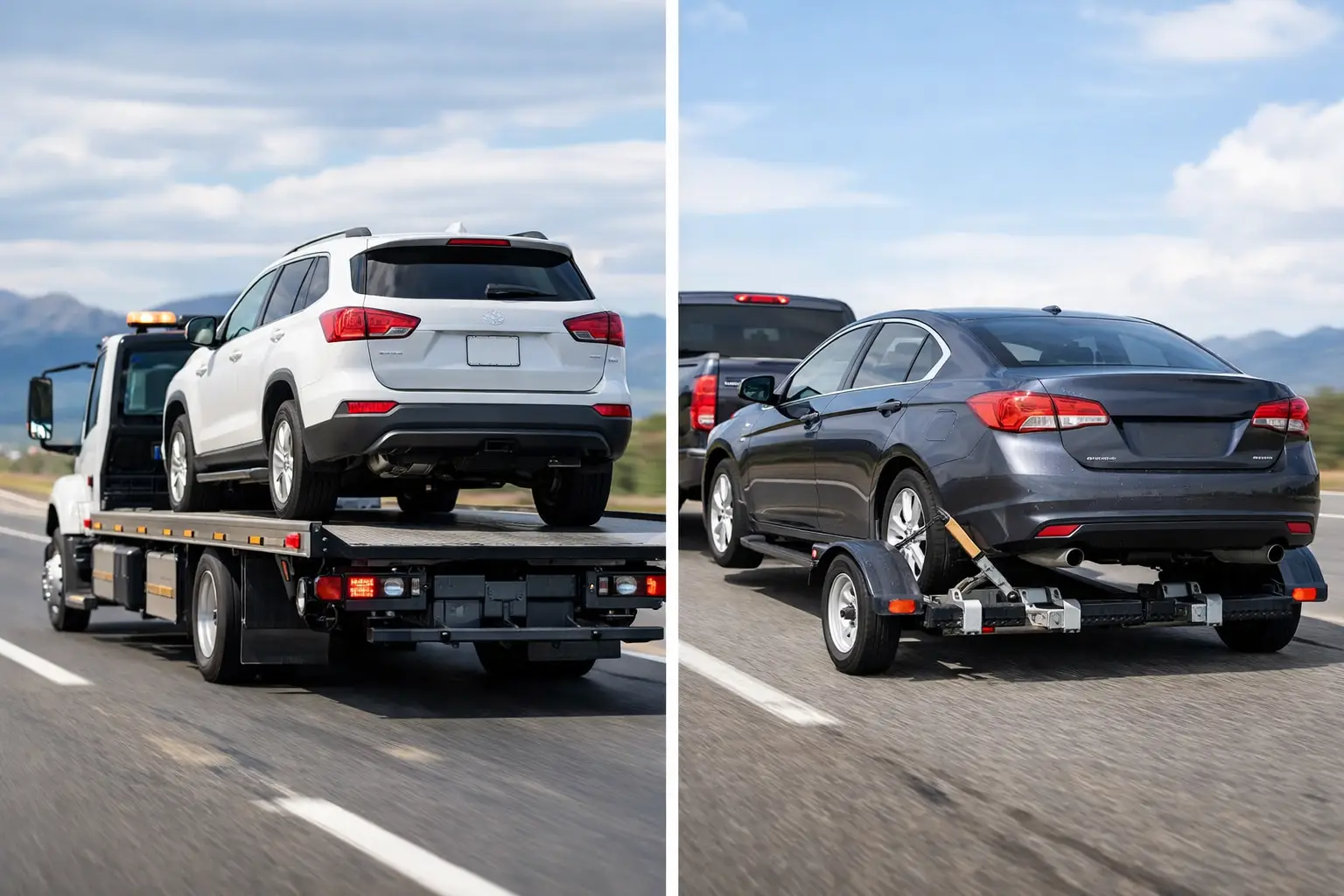
A long-distance tow is not the time to guess. If your car needs to go across town, a lot of methods can work. If it needs to go across Louisiana or farther, the towing setup matters a lot more.
That is where most drivers get stuck. They hear “flatbed” and “dolly” and assume the cheaper option is close enough. Sometimes it is. Sometimes it is exactly how suspension wear, tire issues, or drivetrain damage get added to an already bad day.
When people ask about flatbed towing vs dolly towing for long distance, the real answer is not that one is always right and the other is always wrong. It depends on the vehicle, the condition it is in, the route, and how much risk you are willing to take during transport.
Flatbed towing vs dolly towing for long distance
For most long-distance moves, flatbed towing is the safer and more secure choice. The vehicle is loaded completely off the road, all four wheels are up, and the operator can strap it down for stable transport over highways, bridges, rough pavement, and long mileage.
Dolly towing can still make sense in certain cases. It is commonly used for front-wheel-drive vehicles when the front wheels can be lifted and the rear wheels can roll safely. It can be a practical option for shorter hauls or budget-sensitive jobs, but it comes with more limitations the farther the trip gets.
If you are dealing with a disabled vehicle, an all-wheel-drive system, low ground clearance, accident damage, or unknown mechanical condition, flatbed towing is usually the better call.
What flatbed towing does better on long trips
A flatbed truck carries the entire vehicle on its platform. That one difference changes almost everything about the tow.
The biggest advantage is protection. Since all four wheels are off the ground, the tires do not rotate during transport, the transmission is not being stressed, and the vehicle is not tracking behind the truck for hundreds of miles. That lowers the chance of wear and lowers the chance of something going wrong on the road.
This is especially important for newer vehicles, luxury cars, lowered cars, SUVs with complex drivetrains, and vehicles that have already been in an accident. If a bumper is loose, a wheel is damaged, or steering components are compromised, dragging the vehicle behind a tow truck is not the safest option. A flatbed allows the operator to load it, secure it, and move it with far more control.
Long-distance routes also tend to expose every weakness in a towing setup. Highway speeds, lane changes, weather, potholes, and construction zones all add stress. A vehicle riding on a flatbed is simply more isolated from those variables.
For drivers who want the lowest-risk transport option, flatbed towing usually earns the extra cost.
Best situations for flatbed towing
Flatbed towing is often the right move when the vehicle is all-wheel drive, rear-wheel drive with concerns about driveline protection, not running, badly damaged, low to the ground, or headed a long way. It is also a smart choice if you are transporting a specialty vehicle, motorcycle, small SUV, or anything you do not want rolling on the road for hours.
If the vehicle condition is unclear, flatbed is the safer default.
Where dolly towing can work
A tow dolly lifts one axle off the ground while the other axle stays on the road. In real-world use, that usually means the front wheels are up and the rear wheels roll behind the truck.
That setup can work well for the right vehicle. Front-wheel-drive cars are the usual fit, especially when the rear tires, wheel bearings, and suspension are in decent shape. For the right tow, a dolly can be a cost-conscious option that still gets the car moved safely.
But long distance changes the equation. The wheels left on the road are still absorbing mileage. The tires are still turning. The suspension is still working. And if there is any hidden issue with alignment, wheel bearings, brakes, or rear-end components, a longer trip gives that problem more time to show up.
That does not mean dolly towing is unsafe across the board. It means it is more conditional. The vehicle has to be a good candidate, and the operator has to confirm the setup is appropriate.
Best situations for dolly towing
Dolly towing makes the most sense when the vehicle is front-wheel drive, the distance is moderate, the car is otherwise roadworthy in the axle that remains on the ground, and the goal is a practical lower-cost transport method.
It is less ideal when the trip is very long, the vehicle has existing damage, or there is any doubt about drivetrain compatibility.
The drivetrain question matters more than most drivers realize
One of the most expensive towing mistakes is choosing a method that does not match the vehicle’s drivetrain.
Many all-wheel-drive vehicles should not be dolly towed because leaving two wheels on the ground can create drivetrain damage. Some rear-wheel-drive vehicles also require special handling depending on design and condition. Even among front-wheel-drive vehicles, manufacturer guidance can vary.
That is why the towing company should ask detailed questions before dispatch. Make, model, year, whether the vehicle runs, whether any wheels are locked, and whether there is accident damage all matter. A professional operator does not just send the nearest truck. They send the right truck.
For long-distance towing, that decision becomes even more important because any mismatch gets amplified over time and miles.
Cost matters, but so does total risk
A lot of customers start with price, and that is understandable. If your car broke down unexpectedly, every dollar matters.
Dolly towing is often less expensive than flatbed service. There is usually less equipment involved, and for a straightforward local tow, it may be all you need. But the cheapest quote is not always the lowest-cost outcome.
If a dolly tow saves money upfront but creates wear on the vehicle, limits compatibility, or increases the chance of transport issues over a long trip, that lower rate can stop looking like a bargain pretty quickly. Flatbed service often costs more because it offers more protection, broader vehicle compatibility, and more secure transport.
For long hauls, many drivers decide that paying more for a flatbed is worth it for the peace of mind alone.
Safety and loading conditions should drive the decision
Long-distance towing is not just about what happens once the truck is moving. Loading conditions matter too.
If your vehicle is stuck in a tight parking garage exit, has a broken wheel, sits very low, or cannot be shifted normally, the operator may need a flatbed with the right equipment to load it safely. If there is accident damage, dragging or partially lifting the vehicle can make things worse.
A trained tow operator will look at ground clearance, wheel condition, steering response, and where the vehicle is being picked up. These details affect whether a dolly is even a good option in the first place.
That is one reason many emergency and recovery situations end up on a flatbed, especially when the destination is far away.
How to choose the right towing method
If you are deciding between the two, start with the basics. What kind of vehicle is it? Does it run? Is it front-wheel drive, rear-wheel drive, or all-wheel drive? Are any tires flat? Has it been in a collision? How far is it going?
If the tow is long distance and you want the safest general answer, go with flatbed towing. It is the more versatile option, the safer fit for a wider range of vehicles, and the better method when condition or compatibility is uncertain.
If the vehicle is front-wheel drive, mechanically sound on the rolling axle, and the operator confirms it is a proper candidate, dolly towing may be a reasonable option. The key is getting that decision from a licensed and insured towing team that handles these calls every day.
At Zain Towing LLC, the focus is simple: send the right truck, secure the vehicle correctly, and get it moved without adding stress or damage. If you need long-distance towing in the Kenner or New Orleans area, call now or request a quote at https://zaintowing.net/.
When the tow is measured in hours instead of minutes, the best choice is usually the one that protects your vehicle first and your budget second.
Need help right now?
Zain Towing runs 24/7 in Kenner, New Orleans, Metairie, Harahan and Gretna. Call (504) 666-9099 or see our towing service, roadside assistance and New Orleans pages.