Flatbed or Wheel Lift: Which Tow Is Safer?
A dead battery in a parking lot is one thing. A damaged suspension after a bad tow is a much bigger problem. If you're stuck and asking whether you need a flatbed or wheel lift, the right answer depends on your vehicle, where it is, and what condition it's in.
For drivers in Kenner and New Orleans, this usually comes down to one priority - getting the vehicle moved fast without creating new damage. That is why the tow method matters. A professional dispatch team does not just send any truck. They send the right truck for the vehicle, the location, and the type of problem.
Flatbed or Wheel Lift: What's the Difference?
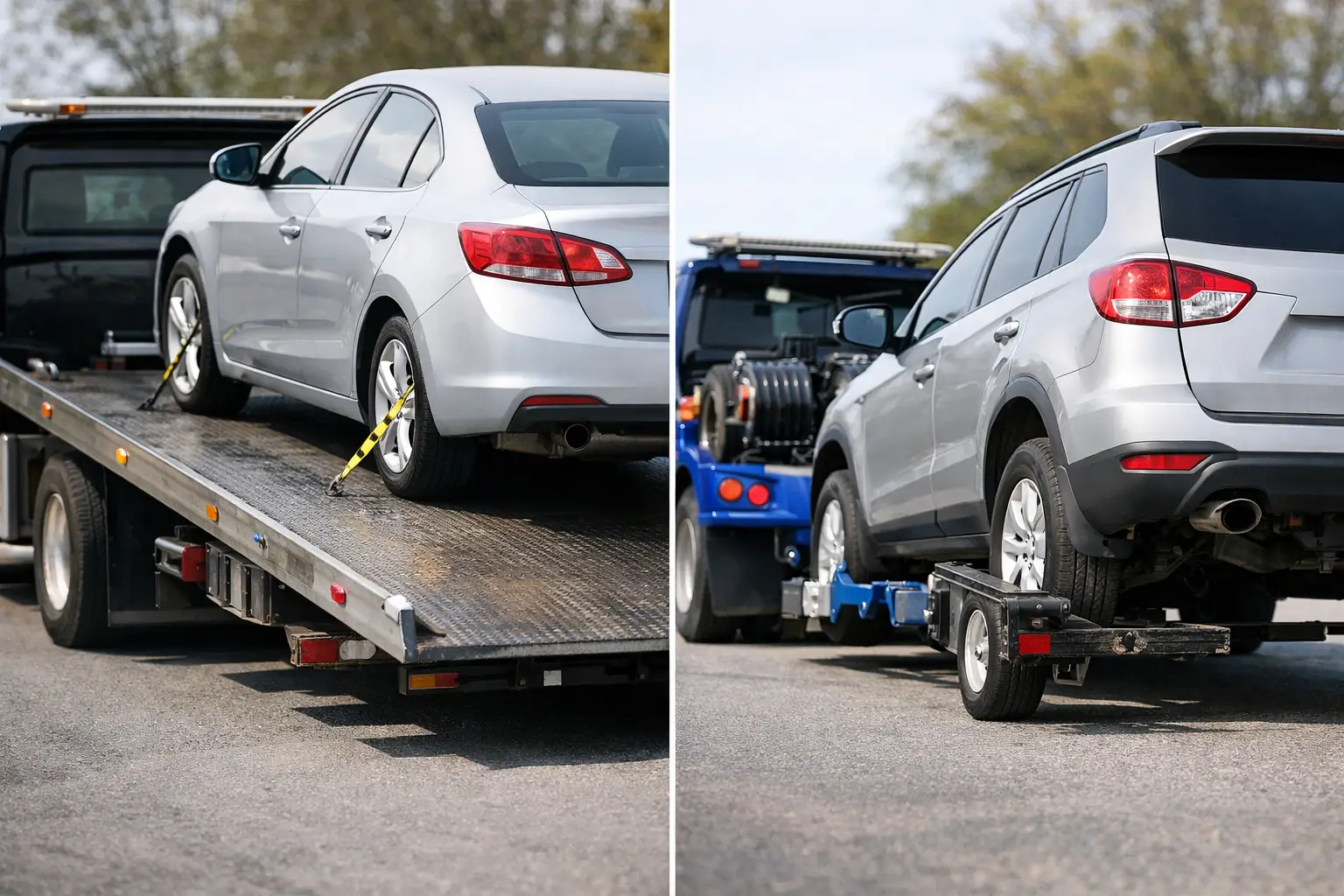
A flatbed tow truck carries the entire vehicle on a platform. All four wheels are off the ground during transport. This method is widely used for vehicles that need extra protection, have mechanical damage, or should not roll on their own tires.
A wheel lift tow truck uses a metal yoke to lift two wheels off the ground while the other two stay on the road. It is efficient, fast to hook up, and often ideal for shorter local tows when the vehicle can safely roll.
Both methods are legitimate. Neither is automatically better in every situation. The safe choice depends on the vehicle type and the circumstances at pickup.
When a Flatbed Tow Makes More Sense
Flatbed towing is often the best option when safety and vehicle protection come first. If a car has all-wheel drive, very low ground clearance, major accident damage, or a broken axle, a flatbed is usually the right call. It also makes sense for motorcycles, luxury vehicles, classic cars, and vehicles being transported long distance.
The biggest advantage is simple - the vehicle is fully off the road. That reduces wear on tires and drivetrain components and helps avoid complications during transport. If the car cannot be driven, cannot roll evenly, or has body damage that makes loading more delicate, a flatbed gives the operator more control.
This is also the preferred method when a customer wants maximum peace of mind. If you are moving a newer vehicle, a specialty vehicle, or something with custom wheels or a lowered suspension, flatbed transport is usually the safer choice.
Best situations for flatbed towing
A flatbed is commonly used after collisions, for non-running vehicles, and for cars with severe mechanical problems. It is also a strong option when a vehicle needs to be recovered from a tricky position and loaded carefully instead of being pulled with two wheels on the road.
In heavy rain, on uneven ground, or after roadside incidents, the extra stability of a flatbed can matter. It gives the operator more options for secure loading and tie-downs, especially when vehicle condition is uncertain.
When a Wheel Lift Tow Is the Better Fit
A wheel lift tow truck is often the quickest and most practical answer for standard vehicles that can still roll and do not require full-bed transport. It works well for many front-wheel-drive or rear-wheel-drive cars, especially when the tow is local and the vehicle does not have damage affecting the wheels, steering, or suspension.
Wheel lift towing is also useful in tight spaces. Parking garages, apartment lots, narrow streets, and crowded roadside shoulders can make a flatbed harder to position. In those situations, a wheel lift truck can often get in and out faster.
That speed matters when traffic is building, when a vehicle is blocking access, or when you just need to get off the shoulder safely. A trained operator can secure the vehicle quickly and move it without unnecessary delay.
Best situations for wheel lift towing
Wheel lift towing is commonly used for breakdowns, short-distance moves, and roadside assistance situations where the vehicle is otherwise intact. If the car simply will not start, has a minor issue, or needs to be taken to a local shop, a wheel lift may be the most efficient option.
It is also a common choice for vehicle relocation and some private property towing because it is fast and maneuverable. But it still has limits, which is why dispatch should always ask about drivetrain, damage, and vehicle condition before sending a truck.
Which Tow Method Is Safer for Your Vehicle?
If the question is pure vehicle protection, flatbed towing usually wins. Keeping all four wheels off the ground lowers the risk of drivetrain stress, tire wear, and road contact during the tow. For many vehicles, especially all-wheel-drive models, that matters.
But safer does not always mean flatbed in every case. A properly performed wheel lift tow is safe for many vehicles when used under the right conditions. The real issue is not flatbed versus wheel lift in the abstract. It is whether the operator is using the correct equipment for that specific vehicle.
A bad match causes problems. Towing the wrong drivetrain setup the wrong way can lead to transmission or differential damage. Trying to move an accident-damaged vehicle with a method that does not support it properly can make body or suspension issues worse. That is why experienced towing companies ask the right questions before dispatch.
Vehicle Type Matters More Than Most Drivers Realize
A lot of customers do not know whether their vehicle should be flatbed towed, and that is normal. Most people are dealing with a breakdown, a crash, or a roadside emergency. They are not thinking about drivetrain configuration.
Still, a few basic rules help. All-wheel-drive vehicles usually lean toward flatbed towing. Low-clearance cars often do too. Motorcycles are typically better on a flatbed. Vehicles with wheel damage, steering damage, or severe front-end or rear-end impact also usually need full support.
By contrast, many standard sedans and SUVs with no structural damage can be handled safely by a wheel lift truck for short local transport. The key word is safely. If there is any doubt, the more protective method is often the better call.
Flatbed or Wheel Lift for Accidents, Breakdowns, and Tight Spaces
After an accident, flatbed service is often the safest move because damaged vehicles may not roll straight or support their own weight evenly. Broken components are not always visible at first glance. Even if the damage looks minor, dragging or rolling the vehicle the wrong way can create more issues.
For a simple breakdown, the answer depends on what failed. An engine problem with no wheel or drivetrain damage may be fine for wheel lift towing. A transmission failure, locked wheel, or broken suspension part may point toward a flatbed.
In tight spaces, wheel lift trucks have an advantage. They can often access places where a flatbed has limited room to load. That does not make them better overall. It just means the pickup environment can influence the best choice.
Why Professional Dispatch Makes the Difference
The most important part of the decision often happens before the truck arrives. Good dispatch is not just fast. It is accurate. The operator or dispatcher should ask what kind of vehicle you have, whether it was in an accident, whether it can roll, and where it is located.
That information helps match the job to the right truck the first time. It saves time, avoids unnecessary risk, and gets you moving sooner. For drivers under stress, that matters just as much as the tow itself.
A licensed and insured towing company with trained operators should be able to explain the choice in plain language. You should not have to guess whether your car is being handled the right way.
What to Tell the Towing Company When You Call
If you need service, be ready to say whether the vehicle is front-wheel drive, rear-wheel drive, or all-wheel drive if you know it. Mention any accident damage, flat tires, locked wheels, fluid leaks, or low ground clearance. Also describe the location clearly, especially if you are in a garage, on a narrow street, or stuck in a difficult position.
Those details help the company decide between a flatbed and a wheel lift without wasting time. If you do not know the technical details, just describe what happened. A professional team can usually identify the safest tow setup from the symptoms and the vehicle type.
When every minute counts, the goal is simple: send the right truck, load the vehicle safely, and get it where it needs to go without adding damage or delay. If you are ever unsure between flatbed or wheel lift, the safest move is to call a trained local towing company that can make that call for you and get help on the way fast.
Need help right now?
Zain Towing runs 24/7 in Kenner, New Orleans, Metairie, Harahan and Gretna. Call (504) 666-9099 or see our towing service, roadside assistance and New Orleans pages.