Flatbed or Wheel Lift Towing?
A tow truck shows up, and most drivers ask the same thing right away - are you putting my car on the bed, or are you lifting it by the wheels? That question matters more than most people realize. The right towing method can protect your vehicle, reduce extra wear, and make the whole situation faster and less stressful.
If you are comparing flatbed towing vs wheel lift towing, the short answer is this: flatbed towing is usually the safest option for full vehicle transport, while wheel lift towing is often the faster and more practical choice for certain short-distance or tight-access jobs. The best method depends on your vehicle, its condition, where it is parked, and where it needs to go.
Flatbed towing vs wheel lift towing: what is the difference?
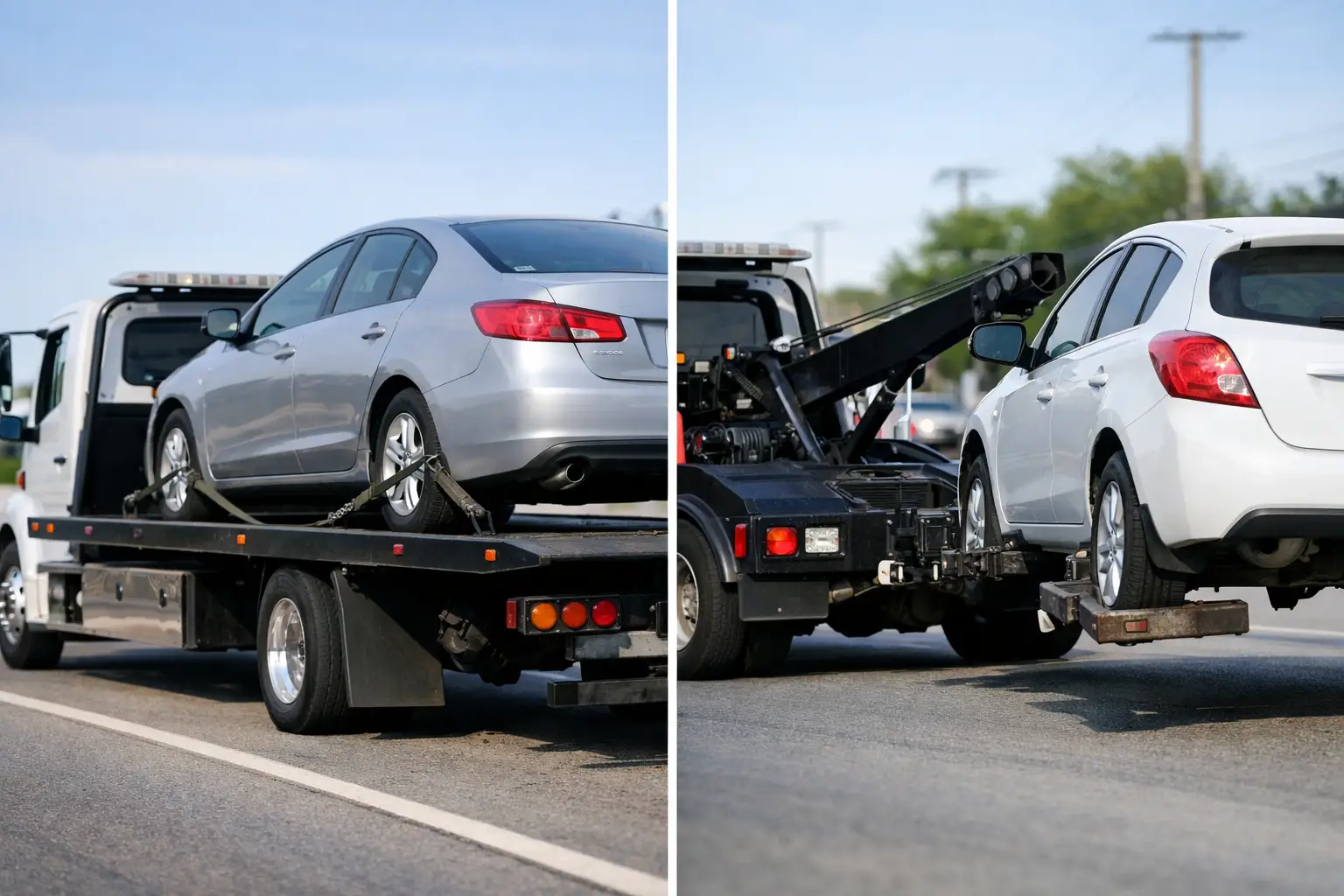
Flatbed towing means the vehicle is loaded completely onto a truck bed. None of the tires stay on the road during transport. The operator uses ramps or a rollback bed and secures the vehicle in place for the trip.
Wheel lift towing works differently. A metal yoke lifts either the front or rear wheels off the ground while the other two wheels remain on the road. This setup is common for standard passenger vehicles, quick relocations, and situations where there is limited room to load a full flatbed.
To a stranded driver, both are just tow trucks. To a trained operator, they are two different tools for two different jobs.
When flatbed towing is the better call
Flatbed towing is the go-to option when vehicle protection is the top priority. Because the entire vehicle rides off the road surface, there is less risk of drivetrain strain, tire wear, or road-related movement during transport. That matters for luxury cars, low-clearance vehicles, all-wheel-drive models, motorcycles, and vehicles with serious mechanical damage.
It is also the safer choice after an accident. If a car has broken suspension parts, wheel damage, severe front-end impact, or fluid leaks, dragging part of it down the road is not a good plan. A flatbed allows the operator to load and secure the vehicle with more control.
This method is also a strong fit for long-distance hauling. If your vehicle needs to go across town, to a repair shop, to a body shop, or farther out of the New Orleans area, having all four wheels off the ground reduces unnecessary movement and exposure.
For many drivers, flatbed towing brings peace of mind. If you drive a newer vehicle, a specialty vehicle, or anything you simply do not want to risk, flatbed service is often worth requesting.
Vehicles that often need flatbed towing
Flatbeds are commonly preferred for all-wheel-drive and four-wheel-drive vehicles, motorcycles, lowered cars, high-value vehicles, classic cars, and damaged vehicles that cannot roll safely. They are also useful when a car is stuck in a way that requires careful recovery before transport.
That does not mean every sedan or SUV must be towed on a flatbed. It means the stakes are higher when the wrong method is used.
When wheel lift towing makes sense
Wheel lift towing is still a professional and effective option when used in the right situation. It is commonly used for standard front-wheel-drive or rear-wheel-drive vehicles that are being moved a shorter distance and do not have major damage affecting the lifted axle or steering.
One big advantage is maneuverability. In crowded parking lots, apartment complexes, narrow city streets, and garages, a wheel lift truck can often get into places a flatbed cannot access as easily. That can save time when every minute matters.
Wheel lift towing can also be more efficient for quick service calls. If a vehicle needs to be moved from a shoulder, relocated from private property, or taken a short distance to a nearby repair facility, this method may be the fastest route to getting the job done.
A lot depends on setup. A trained, licensed, and insured operator will look at the drivetrain, the condition of the tires and wheels, the ground clearance, and any accident damage before deciding if wheel lift towing is appropriate.
The main trade-off with wheel lift towing
The trade-off is simple. Two wheels stay on the road. That is not ideal for every vehicle, and it is definitely not the right move for every breakdown.
For example, towing certain all-wheel-drive vehicles with only two wheels lifted can cause drivetrain damage if the vehicle is not handled with the correct equipment. A vehicle with locked wheels, transmission problems, or structural damage may also need a flatbed instead. So while wheel lift towing can be fast and cost-effective, it is more dependent on vehicle type and condition.
Which towing method is safer?
If you are asking purely from a damage-prevention standpoint, flatbed towing is generally safer. With all four wheels off the ground, there is less chance of wear during transport and fewer compatibility concerns with modern drivetrains.
That said, safety is not just about the truck type. It is also about the operator using the right equipment for the right vehicle. A properly performed wheel lift tow for the correct vehicle can be completely safe. A poor towing decision, on the other hand, can create problems even with good equipment.
This is why dispatch matters. When you call for service, details like make, model, drivetrain, accident damage, and whether the car can roll help determine what should be sent. The fastest truck is not always the right truck.
Flatbed towing vs wheel lift towing for common local situations
Around Kenner and New Orleans, towing calls come from highways, neighborhoods, job sites, airport routes, hotel parking lots, and tight commercial spaces. Each one changes the decision.
If your car broke down on I-10 and needs to go to a repair shop, a flatbed may be the best choice, especially if the issue is unknown or the vehicle has transmission trouble. If your vehicle is stuck in a narrow parking area and needs a short tow out, a wheel lift truck may be more practical.
If you were in a collision, flatbed towing is usually the safer move. If you have a standard vehicle with no major damage and need a quick local transport, wheel lift towing may be enough. This is where trained dispatch and experienced operators make the difference.
Cost, speed, and convenience
Drivers often want to know if one option is cheaper. In some cases, wheel lift towing can cost less because the equipment and loading process may be simpler. But cost should not be the only factor, especially if the wrong choice risks damage to the vehicle.
Flatbed towing may take slightly more room and setup time, but it can save you from a much bigger repair bill later. For higher-value vehicles or vehicles with mechanical issues, that extra protection usually makes sense.
Speed also depends on the scene. A wheel lift truck may hook up faster in a tight spot. A flatbed may be faster overall when the vehicle is badly damaged because it avoids the complications of trying to tow it with wheels on the road.
How to know what to request when you call
If you are not sure which towing method you need, that is normal. Most drivers are not expected to know. What helps is giving clear information when you call.
Tell the dispatcher whether the vehicle was in an accident, whether it can roll, whether it is front-wheel drive, rear-wheel drive, or all-wheel drive if you know it, and whether it is parked in a tight space. Mention if the car sits low, has custom wheels, or has visible axle, tire, or suspension damage. Those details help send the right truck the first time.
At Zain Towing LLC, the goal is simple - dispatch the right equipment fast, protect the vehicle, and get you moving again with as little stress as possible. That means matching the tow method to the real condition of the vehicle, not guessing on arrival.
The better tow is the one that fits the job
Flatbed towing is often the best choice when safety, vehicle protection, and secure transport come first. Wheel lift towing is a smart option when the vehicle is compatible, the route is shorter, and access is tight. Neither method is automatically better every time.
What matters is having a trained operator who knows the difference, shows up prepared, and puts your vehicle on the right truck from the start. When you are stranded, the best next step is not to worry about the equipment - it is to call a local team that already knows how to make the right call.
Need help right now?
Zain Towing runs 24/7 in Kenner, New Orleans, Metairie, Harahan and Gretna. Call (504) 666-9099 or see our towing service, roadside assistance and New Orleans pages.