When Do You Need a Tow? Signs to Call Now
A warning light is one thing. A vehicle that will not steer, stop, start, or stay safely in its lane is another. When do you need a tow? The answer is simple: call for professional towing whenever driving could put you, your passengers, other motorists, or your vehicle at greater risk.
For drivers in Kenner and New Orleans, a breakdown can happen in heavy traffic, during a summer storm, on a bridge, or late at night when help feels far away. You do not need to diagnose every mechanical problem before making the call. Your first job is to get to a safe location if possible, turn on your hazard lights, and avoid making a bad situation worse.
When Do You Need a Tow Immediately?
Some problems are clear no-drive situations. If the vehicle is involved in a collision, has visible damage around the wheels, is leaking fluid, has smoke coming from under the hood, or has lost steering or braking response, do not try to “make it home.” Request a tow.
A tow is also the right call if your vehicle has stalled in a dangerous location, such as a busy roadway, interstate shoulder, parking-garage ramp, flooded street, or area with limited visibility. Even if the engine restarts, the original problem may return without warning. A trained tow operator can load and secure the vehicle, then transport it without asking you to take another chance in traffic.
After a Collision
Even a low-speed accident can damage parts that are not easy to see. A bent suspension component, cracked wheel, damaged tire, leaking radiator, or shifted bumper can make the vehicle unsafe to drive. If airbags deployed, a warning light remains on, a wheel points in the wrong direction, or the car pulls hard to one side, it needs towing and a professional inspection.
Do not let an undamaged-looking exterior convince you that the vehicle is fine. Driving a collision-damaged car can turn a repairable issue into more expensive damage.
Smoke, Steam, or a Strong Burning Smell
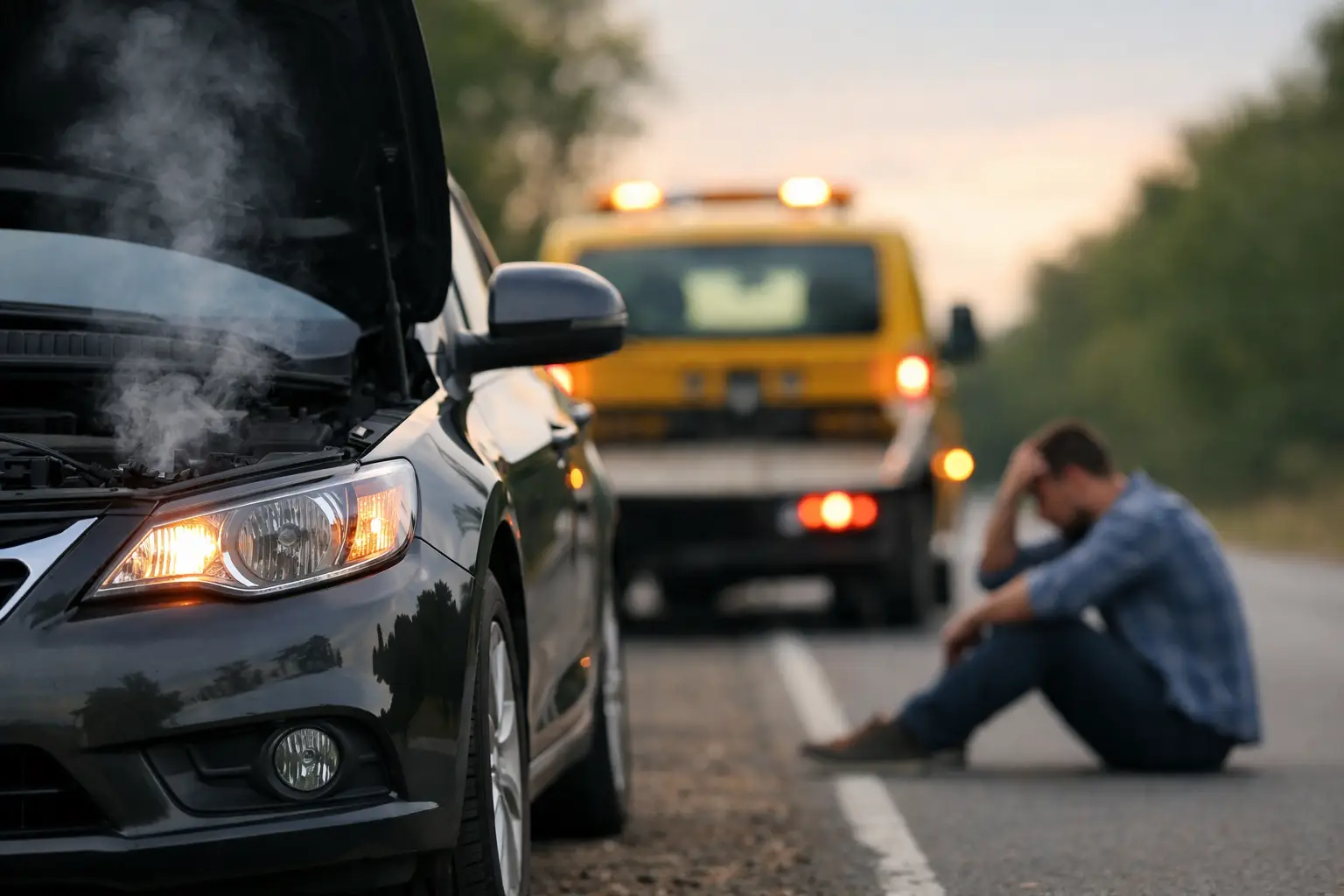
Smoke from the engine compartment, steam from an overheated engine, or the smell of burning rubber, oil, or wiring all require caution. Pull over safely, turn off the engine, and move away from traffic. Do not open a hot radiator cap or pour water onto a hot engine.
An overheating issue can come from a coolant leak, failed fan, broken belt, radiator problem, or internal engine damage. Continuing to drive can cause severe engine failure. Towing is usually less costly than replacing an engine.
Brake, Steering, or Wheel Problems
If the brake pedal sinks, the vehicle will not stop normally, the steering wheel feels loose, or a wheel is wobbling, stop driving as soon as it is safe. These are not problems to test on the road. The same applies to a flat tire when the tire is shredded, the wheel is damaged, you do not have a usable spare, or you are stopped where changing it would be dangerous.
Roadside tire help may be enough for a simple flat in a safe location. But if the tire failure damaged the rim or suspension, a tow is the safer choice.
Problems That May Need Roadside Help Instead
Not every vehicle issue requires a tow truck to haul your car. Sometimes quick roadside service gets you moving again. The decision depends on whether the fix is safe, straightforward, and likely to last long enough for you to reach your destination or a repair shop.
A dead battery is a common example. If the battery simply needs a jump-start and the vehicle runs normally afterward, you may be able to continue driving. Still, if the battery dies again, the alternator warning light is on, or the engine stalls after the jump, do not keep attempting to drive. You may need a tow to avoid being stranded again a few miles later.
A lockout usually calls for professional lockout service, not towing. A spare tire installation can solve a simple flat. Running out of fuel may only require a fuel delivery. These services can get you back on the road quickly when there is no larger mechanical or safety problem.
The key question is not whether the vehicle can move. It is whether it can move safely and reliably. If you are unsure, choose towing. A professional operator can assess the situation on arrival and dispatch the right service for your vehicle.
Mechanical Issues That Should Not Be Ignored
Certain dashboard warnings or drivability changes may allow you to pull off the road, but they should not be ignored. A flashing check-engine light can signal an active engine misfire that may damage the catalytic converter. Low oil pressure, high engine temperature, battery charging warnings, and transmission alerts can also point to problems that get worse with every mile.
Call for a tow if the vehicle is losing power, shifting harshly, revving without accelerating, making loud knocking or grinding sounds, or leaking red, green, orange, black, or clear fluid. The color alone will not tell you exactly what failed, but any substantial leak is a reason to stop and get professional help.
For electric vehicles and hybrids, warning messages, charging-system faults, and underbody damage deserve extra care. Tell dispatch the vehicle type and any warning messages you see. Proper loading and transport methods help prevent additional damage.
Why the Type of Tow Matters
The right truck and loading method protect your vehicle. Flatbed towing is often the preferred option for all-wheel-drive vehicles, luxury vehicles, low-clearance cars, motorcycles, vehicles with serious wheel damage, and cars involved in accidents. Keeping all four wheels off the ground reduces the risk of drivetrain or tire damage during transport.
Wheel-lift towing can be appropriate for certain vehicles and shorter local moves when the vehicle is in suitable condition. Medium-duty towing may be needed for larger trucks, vans, RVs, or heavier equipment. The dispatcher needs accurate details so the operator arrives with the proper truck, equipment, and securement setup.
When you call, be ready to share your location, vehicle make and model, condition of the vehicle, whether it is in a safe accessible spot, and where it needs to go. Mention locked wheels, a flat tire, accident damage, low ground clearance, or anything blocking access. These details help avoid delays and ensure safe handling.
What to Do While You Wait for the Tow Truck
Once service is on the way, focus on your safety. If your vehicle is on a busy road and you can safely exit it, move away from traffic and stand in a protected area. Do not remain beside the vehicle on the traffic side. At night, keep hazard lights on if the vehicle has power, but do not drain the battery trying to run every accessory.
Keep your phone charged if possible and watch for communication from dispatch. Gather your keys, identification, registration, and any important belongings you need from the vehicle. If you are leaving the car at a repair shop after hours, confirm where it should be dropped and whether the shop needs the keys placed in a designated location.
Never accept a tow from an unverified person who appears at the scene without being dispatched by you, law enforcement, or your roadside provider. Ask for the company name and confirm the destination before the vehicle is loaded. Licensed and insured service matters when your vehicle is being transported.
Fast Help When You Are Stuck
A breakdown is stressful enough without guessing whether you should drive another mile. If the vehicle is unsafe, damaged, overheating, leaking, unable to steer or brake correctly, or stranded in a hazardous location, call for a tow now. Zain Towing LLC provides 24/7 towing, recovery, and roadside assistance throughout the Kenner and New Orleans area, with trained operators focused on secure vehicle handling.
Trust the warning signs. Pull over safely, protect the people with you, and let a qualified tow operator get your vehicle where it needs to go.
Need help right now?
Zain Towing runs 24/7 in Kenner, New Orleans, Metairie, Harahan and Gretna. Call (504) 666-9099 or see our towing service, roadside assistance and New Orleans pages.